If you lived in São Paulo in the early to mid-1960s you could not have missed watching 'Show do Meio Dia', a daily variety show on Channel 9, TV Excelsior at mid-day, compered by singer & MC Hugo Santana. Hugo became a sort of King of Day Time TV.
José Hugo Santana de Vasconcellos was born on 5 December 1936, in Palmeira dos Indios, Alagoas, northeastern coast of Brazil. His father died in 1939, when Hugo was only 3 years old - so his mother took him and moved to João Pessoa, further up north in the state of Paraíba.
At 13, when he was at the 6th grade (2a serie ginasial) he was expelled from school due to his association with school bullies. From bad to worse he spent some time at a children's reformatory where he found out to his surprise he enjoyed singing. After leaving the correctional facility Hugo worked for an uncle in Recife-PE.
In 1952, when Hugo was 16 years old he up and left João Pessoa to try his luck in Rio de Janeiro-DF. Hugo tells us he took a 'pau-de-arara' - a bed-truck with wooden seats and a covering canvas - all the way to the Nation's capital. Those trips usually took 15 to 20 days.
Hugo stayed at another uncle's house in Rio and worked as a clerk, dry-cleaner's hand, bread-delivering boy, car-wash hand, ticket-taker at a local cinema etc. He made friends with a fellow who played the guitar and kindly accompanied him when he sometimes felt like singing. He started doing the round of radio stations to sing at amateur and gong-shows. At first he was gonged at Radio Vera Cruz but fared much better at 'Ai vem o pato' having been the runner-up.
While singing on radio he met actor Sadi Cabral at Teatro João Caetano, who gave him a supporting role in a play he had written called 'Não vou ao Golpe' which was about the ill-fated coup d'etait the military & right-wing gangsters staged against Juscelino Kubistchek who had won the Presidential elections but was in danger of not take power. The company toured Sao Paulo and when it was about time to move on, Hugo decided to stay behind. Not having many choices he became a regular crooner at a Portuguese restaurant for a while, then moved on to the night-club circuit where he met lots of musicians.
Agnaldo Rayol introduced Hugo to TV director Cassiano Gabus Mendes who was impressed with his way of singing and signed him to a 2 year-contract at TV Tupi. Geraldo Vietri, another TV director included Santana in a TV play called 'Os gatos pingados' in March 1960, alongside Lolita Rodrigues, Pery Ribeiro, Dorinha Duval and Geraldo Cunha.
Izio Gross from Mocambo Records signed Hugo and released his first 78 rpm: 'Na rocha da siribeira' backed with 'Seu sorriso' written by Lupercy Fiorini & Oscar Castro Neves.
Hugo recorded for Chantecler; a whole album for Continental Records and ended up at Odeon in 1965, with the theme-song from 'Deusa Vencida' the most popular novela of the year.
Now, there is a gap in Hugo's career from 1966 through the end of the 1960s, but I know Santana left Brazil sometime after 1967 and made himself a brand new career as a TV presenter in San Juan, Puerto Rico. The Brazilian press didn't bother to follow his foreign career but as I lived in the USA in 1971 and 1972, I became aware from Puerto Rican fellow-workers that Hugo Santana had become really popular in that country.
We don't know much more about Santana's destiny after his Puerto Rico phase. I was told Hugo has died but no one knows where or when.
Conheceu o ator Sadi Cabral que o levou para cantar no coral do Teatro João Caetano e estrear como ator na peça “Não Vou no Golpe”, ao lado de Otelo Zeloni.
Em 1960, apresentou o programa “Depois da Meia-Noite”, na Rádio Tupi, e a Revista do Rádio o escolheu como a revelação masculina na premiação de”Os Melhores do Rádio daquele ano.
Na TV Tupi participou de três novelas curtas nessa época e na Rádio Tupi apresentou o programa “Clube de Fãs”. Da Tupi foi para a TV Record e de lá para a TV Excelsior, onde participou da novela “Corações em Conflito” em 1964, e depois de “A Outra Face de Anita”.
Em 1965, participou da novela “A Deusa Vencida” ao lado de Glória Meneses, Édson França e Tarcisio Meira na TV Excelsior. Participou do I Festival da Música Popular Brasileira na TV Record, em 1966, interpretando a música “Fim de Sonho” de Sylvio Mazzuca.
Atuou no programa “Chico Anísio Show” no final dos anos 1960 e também na novela da TV Globo, “Anastácia, a Mulher Sem Destino”, em 1967, ao lado de Leila Diniz e Henrique Martins.
Em 1969, se mudou para a TV Jornal do Comércio de Recife, onde apresentava e cantava em um programa nas noites de sábado. No ano seguinte estava na TV Piratini, o canal 5 da capital gaúcha, apresentando o programa “Super Sábado”.
Em 1972, Hugo Santana se mudou para Porto Rico e se tornou cantor e produtor musical. Retornou ao Brasil dois anos depois e participou como convidado de alguns programas de televisão, principalmente o “Almoço com as Estrelas” e o “Clube dos Artistas”.
Voltou para Porto Rico em 1976, e foi atuar no rádio, onde chegou a fazer um programa religioso e se apresentar como o pastor Hugo Santana. Outro retorno, agora definitivo, ao Brasil onde em 1980, participou como ator de um episódio do seriado “Plantão de Polícia” e fez uma participação especial no seriado “O Bem Amado” e na novela “Chega Mais”.
Trabalhou em seguida na Rádio Palmares, na Rádio Difusora de Alagoas e na Atalaia FM de Aracaju na década de 1980.
Faleceu em 9 Setembro 1990, em João Pessoa, capital da Paraíba.
Hugo at Revista Melodias, May 1966.


1. Chegou a minha vez de amar (What kind of fool am I?) Bricusse-Mewley; adpt.: Hugo S.
2. Aconteceu de-repente (Ana Clara Borges)
3. Canção da menina triste ( Edmundo Villani Cortes)
4. Berimbau - Baden Powell-Vinicius de Moraes)
5. Só o amor ficou (Edmundo Villani Cortes)
6. O amor chegou (Hugo Santana)
1. Papagaio azul (Edmundo Villani Cortes)
2. Amanhã chegou (Manquito-André Perez)
3. Caminho do amor (Luiz Vieira-José Di)
4. Sem defeito (Roberto Siom)
5. Enfim você voltou (Mario Albanese)
6. Samba sem porque (Geraldo Cunha)
'Cinelândia', February 1964 record releases...
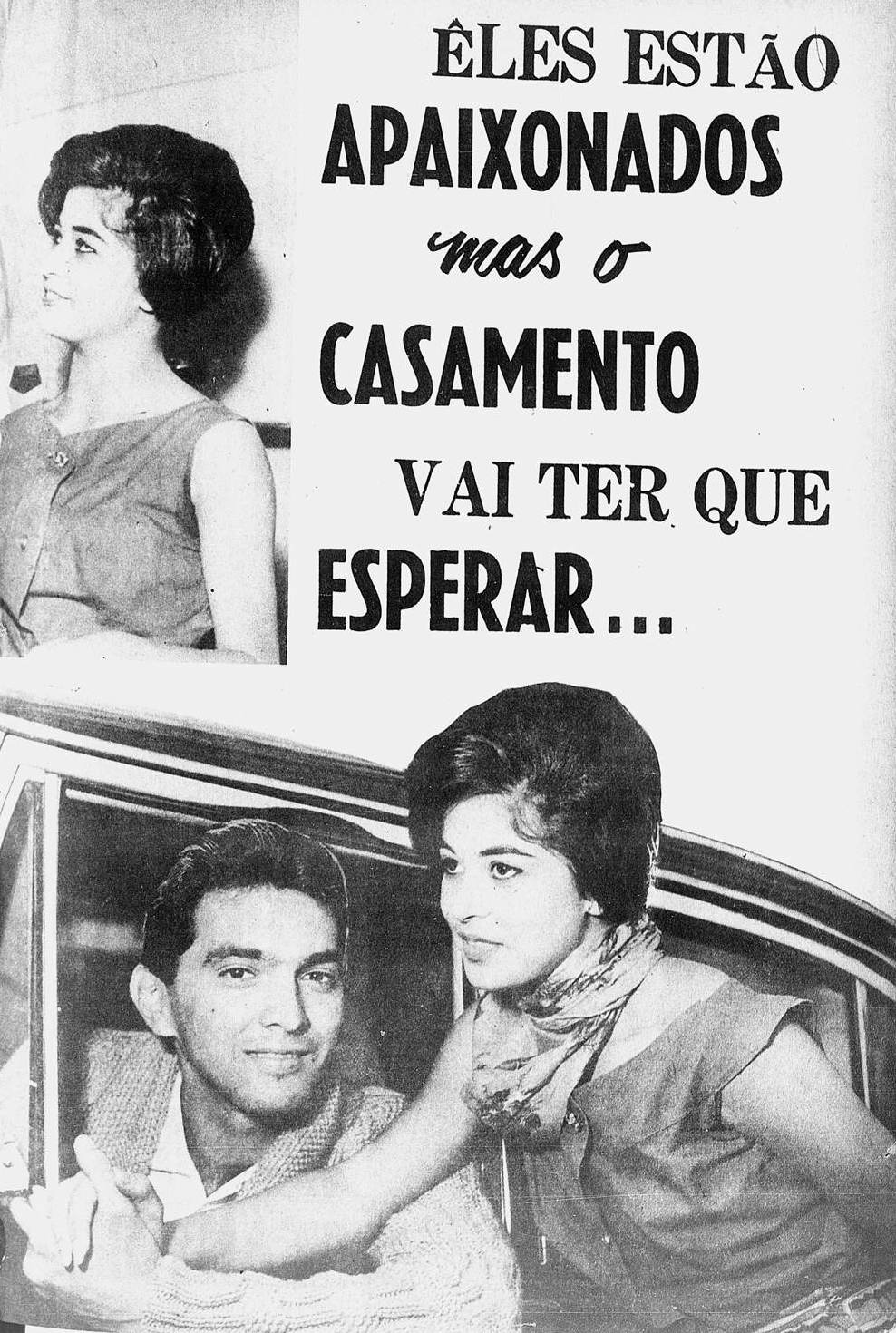
Hugo Santana and new-face Denise Dumont fake a romance for the pages of 'Revista do Radio', 1960.
Best performers of 1960 on Radio and TV in São Paulo; Hugo's biography at 'Revista do Radio', 18 August 1962.
Hugo Santana tells his life-story at 'Revista do Radio'.
more Hugo Santana biographical data at Revista do Radio.
Hugo Santana was a man-of-all-trades at TV Excelsior, Channel 9 during its heydays in the mid-1960s. He started as a singer, then suddenly was the MC of 'Show do Meio Dia', 6 days a week. Hugo also played the lover man in Excelsior's telenovelas. Here Santana plays Mário, married to Rute (Riva Nimitz) in Ivani Ribeiro's 'A outra face de Anita', shown from 28 July 1964 until 25 September 1964.


 Marcos Roberto's first album ever... 1967.
 In 1969, Marcos Roberto, after nearly 10 years of really-trying hits the big time with 'Será?' a ballad. Marcos had started his career in show business in 1959 having recorded a single for Miguel Vaccaro Netto's independent label Young.


 3rd March 1963 - Long before Orlando Alvarado thought about being a rock star - in March 1963, night-life columnist Mary Wynne mentioned him in her column at 'O Estado de S.Paulo': Orlando Alvarado, 'mestre' do Ballet Espanhol das Noites Ibéricas, do restaurante luso-espanhol Noites Ibéricas vai ser homenageado numa grande noite artística terça-feira, 5 Março 1963.
 7 March 1964 - Orlando participou da revista musical apresentada durante a entrega do prêmio Roquette Pinto em 7 Março 1964. Devido ao sucesso do show, ele foi reapresentado nos dias 14 e 15 Março 1964, como abertura do recital do cantor italiano Sergio Endrigo no Teatro Record.


.jpg)

.jpg)
.jpg)


.jpg)




.jpg)
