

Yeda Maria at revista Finesse # 2, August 1962.
Yeda Maria Scaglioni was born in 1943, in São Paulo. She grew up in a very musical family who lived in Pinheiros, São Paulo. Her younger brother Horácio (Horacinho), born in 1951, turned out to be a fine guitarrist and later a jazz bass player.
Yeda recorded first for Copacabana, when she was only 12 years old, moved on to Chantecler and then, finally alighted at RCA Victor.
Her greatest hit was probably 'O segredo', in 1963, a cover of Joaquin Prieto's 'Il segreto' originally recorded by Donatella Moretti in Italy.
After having recorded 5 singles (78 rpms and vynil 33 rpms compactos-simples) for RCA Victor, Yeda slowed down considerably but kept on singing live here and there. In 1970, Yeda sang a chorinho called 'Encabulado', at the II Festival de Música MacKenzista. This was actually Yeda's swan's song for she married and had children.
Yeda Maria died on 23rd October 2015. She was 73 years old.

'Correio da Manhã' 8 August 1954; Yeda Maria records her very first platter for Copacabana Records: 'Dia do Papai', a waltz written by Vitor Simon to celebrate Father's Day.

A vertiginosa carreira do broto Moreira Junior, que lidera audições na Radio Nacional e TV Paulista, com seu 'Ritmos para a Juventude'. O programa é um ponto de reunião da juventude moderna. Lyra Marçal é sua 'partner' e Maximira Figueiredo, a professora 'beca'.
Diáriamente as 16:30, na Radio Nacional, e aos domingos às 14:00 horas na TV Paulista, Moreira Junior produz e comanda a sua audição 'Ritmos para a Juventude', reunindo um sem número de apaixonados do rock, do samba, da bossa nova etc. Sabedores da grande audiência do referido programa, fomos até o seu produtor para sabermos mais sobre esse sucesso.
Moreira Junior é santista de nascimento e iniciou sua carreira na Radio Atlântica como animador infantil. Depois percorreu outras emissoras praianas como Rádio Clube, Cultura, Guarujá e Cacique, como locutor comercial, radio-ator e reporter.
Depois foi para o teatro, trabalhando na Companhia Rosemary-Mauricy, dirigida por Julio Massari. Ganhou algum dinheiro, foi para o Rio de Janeiro, e depois de 3 meses de sacrifício, conseguiu ingressar na Radio Nacional, PRE-8, por teste, como locutor de jornal falado, tendo substituído, inclusive, o Repórter Esso.
Em 1959, conquistou inúmeros prêmios como 'Revelação Masculina', 'Microfone de Ouro', 'Medalha de Ouro' e 2 diplomas.

'Ritmos para a Juventude', on Sunday at TV Paulista; MC Moreira Jr., Lyra Marçal, Yeda Maria & other musicians. Revista Melodias, April 1960.

Lyra Marçal, Maximira Figueiredo & Moreira Júnior at the helm of 'Rítmos para a Juventude'.

Yeda Maria was very active at 'Ritmos para a Juventude'; Melodias, April 1960.

Yeda Maria signs with Chantecler next to Jairo Rodrigues its director. Radiolandia #312, March 1960.


Yeda Maria, Radiolandia #315, May 1960.


March 1960, Radiolandia #316; Yeda Maria & Leila Silva as advertised by Chantecler.

Radiolandia #317 - Alfredo Corleto, Leila Silva, Yeda Maria, director Jairo de Almeida Rodrigues & A&R man Diogo Mulero at the cocktail given by Chantecler to the press.


11 June 1960 - 'Correio da Manhã' - The Platters, Frankie Avalon & Yeda Maria's EP 'Broto é mesmo assim' released by Chantecler; 2 July 1960 - 'Correio da Manhã' - 'Esquina Sonora' written by Nicodemus & Cia.
 12 October 1960 - 'Correio da Manhã' - column 'Cantinho Sonoro' says singer Carlinhos Mafazzoli would marry Yeda Maria before the end of 1960. It probably didn't happen otherwise we would have known about it.

Yeda Maria on the cover of magazine 'SP na TV' - 23 January 1961.

Article about Yeda Maria published at Revista Finesse n. 2 in August 1962.
1. 'Dia do Papai' (Victor Simon) - Copacabana 5242-B - 1954
sung by Yeda Maria & Coro Infantil do Clube dos Garotos G-9 e Orquestra.
'Dia das Mães' (Maria Cecília B. França) - Copacabana 5242-A - 1954
sung by Elza Laranjeira & Clube dos Garotos G-9 Children's Choir & Orchestra.
2. 'Alguém é bobo de alguém' (Everybody's somebody's fool) Chantecler 78-032- 1960
(Howard Greenfield-Jack Keller; version: Fred Jorge)
with Élcio Alvarez, his Orquestra & Choir
'Jardim do amor' (Ivani, Ivan Pires) - Chantecler 78-0329 - 1960
with Poly, his combo & Choir
3. 'Broto é mesmo assim' (Mário Eduardo) Chantecler 78-0248 - 1960
Conjunto de Ritmos e Coro
'Oh baby meu amor' (Mário Eduardo) Chantecler 78-0248 - 1960
with Conjunto de Ritmos e Coro
4. 'Retrato' (Joaquim Prieto; version: Juvenal Fernandes) RCA Victor 80-2401 - 1961
with Francisco Morais & his orchestra
'Vou me vingar' (Belmiro Barrela) RCA Victor 80-2401 - 1961
with Francisco Morais & his orchestra
5. 'O segredo' (El secreto) (Joaquin Prieto; v.:Juvenal Fernandes) RCA Victor 80-2469 - 1962
'Eu não esqueço' (Arquimedes Messina) RCA Victor 80-2469 - 1962
Yeda Maria & Combo
6. 'Despedida' (Belmiro Barrella) RCA Victor 80-2504 - 1962
Yeda Maria & Raul Gil
with Francisco Morais & his orchestra
'Mentira' (F. Pracânico, E. C. Flores; v.: Juvenal Fernandes) RCA Victor 80-2504 - 1962
Yeda Maria & Raul Gil (tango)
with Francisco Morais & his orchestra
7. 'Doce amor' (Henrique de Almeida, Carlos Marques) RCA Victor 80-2557 - 1963
with Combo
'Cinderela' (Paulo Borges) RCA Victor 80-2557 - 1963
with Combo
8. 'Filme triste' (Sad movies make me cry) RCA Victor 80-2530 - 1963
(John D. Loudermilk; v.: Romeu Nunes)
with Orchestra
'O teu nome' (José Lopes- Teixeira Filho) RCA Victor 80-2530 - 1963
with Orchestra
9. 'É de amargar' (Jair Gonçalves-Luiz Augusto) RCA Victor LC-6024 (twist) - Jan. 1964
'Alguém mentiu' (Teixeira Filho- Rogê) RCA Victor LC-6024 (rock-calypso)

September 1963 - Radiolandia columnist Theotonio Pavão with the best-selling singles in Sao Paulo. Yeda Maria is at the top of the charts with 'Cinderela' (Paulo Borges) recorded for RCA Victor, 80-2557, on 22nd April 1963, backed with 'Doce amor'.


'Retrato' written by Joaquin Prieto of 1961, Yeda's first real hit b/w 'Vou me vingar' a Belmiro Barrela samba.


RCA Victor 1963 release: 80-2530 'Filme triste' (Sad movies make me cry) b/w 'O teu nome' a bolero written by José Lopes-Teixeira Filho. As one can see, a ballad-rock singer could sing a bolero on the flip-side too.


LC-6024 'É de amargar' (twist) b/w 'Alguém mentiu' (rock-calypso) released in late 1963., was Yeda Maria's last recording, except for 'Encabulado', a chorinho she recorded in 1970.

Yeda Maria's discography is rather peculiar. Her very first disc was recorded when Yeda was still a child in 1954. It features Elza Laranjeira singing 'Dias das Mães' on side A and Yeda Maria on the B side singing 'Dia do Papai'; both recordings were accompnied by the boys of Clube dos Garotos G-9 Children's Choir. Copacabana Discos knew lots of people would buy those records to give as a present to their mothers or fathers.
Then there was a long hiatus in which Yeda didn't record at all. Six years later, in 1960, when Yeda was still in her teens, she covered Connie Francis' # 1 Country & Western hit called 'Alguém é bobo de alguém' (Everybody's somebody's fool) for Chantecler but somehow it failed to chart. When one listens to Yeda's rendition one realizes Elcio Alvarez wasn't in his best days when he arranged the song. Had Yeda given the same delivery as Miss Connie Francis' she would have made it. For a year later, in 1961, Wilson Miranda re-recorded 'Alguém é bobo de alguém' for the same Chantecler and it shot to Number One soon after. 25 years later, in 1977, Wilson Miranda's 'Alguém é bobo de alguém' went to Number One again on a nostalgia wave caused by telenovela 'Estúpido Cupido'.
Still in 1960, Chantecler released Yeda's 2nd rock single, 'Broto é mesmo assim' b/w 'Oh baby, meu amor' both written by Mario Eduardo who used to write songs Moraes Sarmento. Needless to say the single didn't have much air-play. In the meantime Yeda Maria was signed by major label RCA Victor.
Yeda's 1st single for RCA was 'Retrato', a cover of Chilean singer Antonio Prieto, who had hit the big time with 'La novia', earlier in the year, written by his brother Joaquin Prieto. 'Retrato' turned out to be Yeda's biggest hit so far.
As 1962 dawned, Yeda recorded another Joaquin Prieto song, 'O segredo' (El secreto) which turned out to be a bigger hit than 'Retrato'.
As 1962 progressed, a quirk event happened in the Hit Parade, when fluminense singer Silvana, who had been trying to hit with 'Amor, fonte da vida', recorded a tango for Copacabana Discos called 'Amor' (Grata ventura de querer) with Rinaldo Calheiros, originally from Maceió, Alagoas. Tangos were considered out-of-fashion and had not charted for more than 10 years and all of a sudden, this Brazilian tango written by Antenógenes Silva went straight to Number One. All labels wanted to have another 'dream-couple' like Silvana & Rinaldo... so RCA Victor paired Yeda Maria with Raul Gil and they recorded a tango called 'Mentira'. 'Mentira' went nowhere; it was just a waste of time and money.
In 1963, Yeda Maria recorded 3 singles for RCA: 'Cinderela', written by Paulo Borges which had a bit of air play. Then, with 'Filme triste' a cover of 'Sad movies make me cry' written by John D. Lourdermilk with Portuguese words by Romeu Nunes, Yeda had her swan song. Odeon released the same song by Trio Esperança, a Rio teen-age trio, which went straight to Number One... Yeda's recording barely had any air-play. Yeda's last release was 'É de amargar', a twist written by Jair Gonçalves & Luiz Augusto, b/w a rock-calypso called 'Alguém mentiu', written by Teixeira Filho & Rogê, who was probably Paulo Rogério.

S E L M I T A... a rock dynamo from Maranhão...

'Revista do Radio' no.760 - 11 April 1964.

Selma Aranha Alves aka Selmita was born in São Luiz, Maranhão on 17 August 1945. Selmita was only 4 years old (in 1949) when her father died and as her mother had another daughter and son she had to give her away to some nuns who ran a Catholic boarding school in São Luiz. Apparently, the nuns were great music enthusiasts and taught their children how to perform all kinds of instruments so Selmita had a chance to develop her musical side.
Five years later, in 1954, as Selmita's mother, her brother and sister were ready to migrate to Rio de Janeiro, they went to the nuns', picked Selmita up and brought her along with them through the 2,000 miles south until they reached the Wonderful City.
After getting themselves settled with some relatives, Selmita started singing at 'Clube do Guri', a popular show presented by Collid Filho on Radio Tupi, which eventually went on to TV Tupi, where kids had a chance to showcase their talent.
Suddenly, out of the blue, in 1962, when Selmita was 17 years old, while singing at a friend's birthday party, she was approached by song-writer Moacyr Bastos who took her to Philips where she eventually recorded a 78 rpm single under the direction of Rossini Pinto: 'Eu vivo a cantar' (Rossini Pinto) b/w 'Oh!, meu amor' (Moacyr Bastos-Darcy Silva) and soon Selmita's career was in high gear.
It didn't take too long for Philips to record Selmita's first E.P. (extended-play aka compacto-duplo).


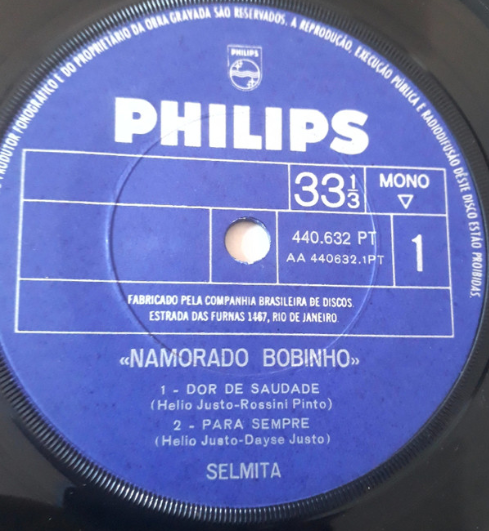

'Se eu não passar de ano' (1965) a cover of 'Se mi bocciano agli esami' with Gianna Forretti

Selmita sings on TV circa 1966.


