Raul Moreno
nee Tufic Lauar was born on 23 July 1923, in Carangola-MG, a town 150 km away from Cachoeiro do Itapemirim-ES.
He worked
as a typesetters at at a newspaper in his hometown. Tufic then moved to Rio de Janeiro. It was while working as a typesetter that Raul met samba
song-writers and soon he was writing sambas too instead of composing pages.
Odete Amaral recorded Moreno’s
‘Tudo é ilusão’ in 1946. He
had other sambas recorded by other singers until 1950, when he decided to record
his own songs and paid for it. When Todamerica’s director Antonio de
Almeida heard the paid-for-single he decided it was too good and released it as a regular record.
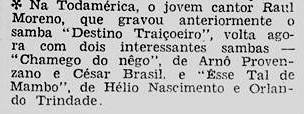
Raul Moreno at 'Carioca' 1951.
Revista do Radio asks whether people liked what righ-wing politician Carlos Lacerda had been doing lately. Lacerda was elected for City Council in 1945; was a Congressman from 1947 to 1955 and ended his infamous career as governor of Guanabara state from 1960-1965. Carlos Lacerda was a major conspirator in the 1964 Military Putsch that ended Brazilian Democracy on 1st April 1964. Ten years earlier - 1954 - Lacerda helped to oust President Getulio Vargas who shot himself in the chest rather then leave office which he had been elected in 1950.
People who worked in Radio & TV usually had their political views too. The ones for Lacerda could be said to lean right... Raul Moreno was absolutely left-leaning.
'Correio da Manhã' 2nd January 1955.
This long article about Raul Moreno was published at 'Correio da Manhã' on 2nd January 1955, in which the daily tells his story since he left Carangola-MG and settled in Rio de Janeiro-DF. According to the paper, Raul started singing professionally in 1945.
Circa 1947, Raul Moreno
was a regular crooner at the Elite Club, a working class dance hall on top of a
funeral home in Praça da Republica in central Rio de Janeiro, attended mostly
by domestic servants and factory workers. He received a 100 cruzeiros per function and
fronted the local orchestra 3 times a week.
Gafieira is the sort of dance hall for the working classes set up mostly in Rio de Janeiro a few years after the end of slavery in 1888. Its meaning comes from the French word 'gaffe' due to the inexperience of those people who had just recently been released from thralldom and didn't know much about ball-room-dancing and consequently made a lot of 'gaffes'.
Well, Moreno was touted as the King of Gafieira by 'Correio da Manhã' which may have been a form a veiled racism but that was really common then. Disdain for the working class was grist to the mill in the mainstream media then.
Finally, in late 1952, things started changing when Raul was chosen by Império Serrano song-writer Monsueto Menezes to record 'A fonte secou' which was not only the best 1953 Carnaval song but kept on playing at the radio waves long after those festivities were over soon becoming a 'standard'.
Moreno was signed by Radio Transmissora and performed with Ruy Rey & his orchestra plus Paulo da Portela.
For Carnaval 1955, Raul Moreno teamed up with Elizeth Cardoso and recorded 'O seresteiro' written by Renato Lima and himself. But Moreno's great hope is for 'Timidez', written by Wilson Baptista & Marcléo, a modern-samba (which would be called 'sambalanço' in the 1960s) that he recorded for Todamerica in May 1954.
2nd January 1955 - 'Correio da Manhã' - Raul Moreno started 1955 all fine... later on he would enter a bad phase of his life when he was accused of statutory rape by a woman.
How the mainstream media could be racist or demeaning to the working class:
'doméstica' is meant by those women who work full-time as servants at white middle-class households and usually have one day-off a week. They're mostly Black women.
'Correio da Manhã' columnist writes: 'We should point out that Raul Moreno is more 'adequate' to gafieiras'. Which really means: Moreno is good enough to perform for those servants and factory hands... and 'who else happened to be lounging there'... (e quem mais andasse por ali)...
Further on the columnist comes up with this pearl of racism and contempt: 'Raul Moreno foi um sábado ao Elite. Combinou com a orquestra o ritmo. Acertou tudo direitinho. E largou para a mulatada: '
The columnist calls the Elite audience 'mulatada', that is: those of mixed blood; those half-negroes! That comes close to call them 'macacada' - a bunch of monkeys!
8 February 1955 - Raul Moreno's presence at Correio da Manhã's 'Caravana Musical' on Saturday night is highlighted in the article published on Tuesday in the newspaper. See future star Alaide Costa in the photo with Moreno.
4 November 1957 - Yolandino Maia's 'Gangerê' featured Raul Moreno in a musical number.
Raul Moreno discography
TA-5162-A - Destino traiçoeiro (Raymundo Olavo-Djalma Mafra) recorded on 11 March 1951.
TA-5162-B - Meu drama (Helio Nascimento-Orlando Trindade)
TA-5387-A - A fonte secou (Monsueto-Tufic Lauar-Mario Luiz Marcléo) - 8 October 1953.
TA-5387-A - Mulher de mau pensar (Monsueto Menezes-Elói Marques) - December 1953.
TA-5417-A - Timidez (Wilson Baptista-Marcléo) - May 1954.
TA-5501-A - Inocente (Wilson Baptista-Brazinha-Marcléo) - recorded on 30 September 1954.
TA-5573-A - Me empresta teu lenço (Monsueto-Elano de Paula-N.Durso) - rec, 4 August 1955.
TA-5586-A - Marcha do golpe (Antonio Almeida-Zé Tinoco) - rec. 27 October 1955.
TA-5680-A - A flor e o espinho (Nelson Cavaquinho-Guilherme Brito-Alcides Caminha) - 14 Feb 1957
Raul Moreno is accused of statutory rape by Etelvina de Oliveira. She said she had met Moreno at Radio Mundial and they started a romance. Moreno whose real name is Tufic Lauar told the Judge they went to the movies on 29 September 1955 at Cinema Odeon and as Etelvina lived in the suburbs they decided to stay at Hotel Estrada de Ferro overnight. Etelvina said it was a lie. She had been seduced and raped by the musician. 'Correio da Manhã' 19 October 1955; 'Correio da Manhã' 17 November 1955.
Raul Moreno died on 25 November 1995.
Raul Moreno's Tiger 78 rpm; as it is made of vynil it is probably a 1963 production.


E L C U B A N I T O
El Cubanito - the man who covered Sonora Matancera's 'Cao cao mani picao' that hit Number One in Brazil on 11 August 1953, was none other than Alvaro Francisco de Paula, who was born on 24 November 1927, in Rio de Janeiro, Brazil.
El Cubanito fronted the orchestra of Waldyr Calmon for this particular disc that Copacabana Records knew could top the charts but was surprised, nevertheless, when it did.
Later on, El Cubanito formed his own big band and toured Brazil for years. He even recorded for Nilo Sergio's Musidisc label that released his recordings in stereo for the U.S. and Brazilian markets. At some stage Alvaro Francisco had to give up his post as a civil servant at the Ministry of Economy to dedicate his whole time to his act which was large.
Cao cao cao mani picao, cao cao
cao cao cao mani picao, cao cao
Lo quiere la gente (cao cao)
ay, lo dice la gente (cao cao)
pero le gusta a la gente (cao cao)
ay, lo baila la gente (cao cao).
Quiquiriquí picao, quiquiriquí picao, quiquiriquí picao
arriba é la tabla mani picao, cao cao.
A mi, qué me importa (cao cao)
ay, yo vivo mi vida (cao cao)
a ti, qué te importa (cao cao)
pero tú vives tu vida (cao cao).
Quiquiriquí picao, quiquiriquí picao, quiquiriquí picao
arriba é la tabla mani picao, cao cao.
Dame una candelita (allí fumé)
ay, dame una candelitta (allí fumé).
Quiquiriquí picao, quiquiriquí picao, quiquiriquí picao
arriba é la tabla mani picao, cao cao.
Cao cao cao mani picao, cao cao
eh maní picao, cao
arriba é la tabla maní picao, quiquiriquí
cao cao cao maní picao, cao cao
Ay, pero cao cao cao
arriba é la tabla mani picao, quiquiriquí
cao cao cao mani picao, cao cao.
'Cao, cao mani picao' - guaracha written by Jose Carbó Menéndez; it was originally recorded in Cuba by Sonora Matancera featuring Celia Cruz in her first recording with the band.
'Revista do Radio' tells its readers El Cubanito is a coloured-man and has recorded 'El gopecito' b/w 'El tiempo será testigo' two mambos...
El Cubanito's real name is Álvaro Francisco de Paula. He is a singer signed to Radio Mundial. Alvaro lives in Cachambim, a Meier suburb. He's married with no children. He really enjoys singing in the shower and Italian food is a must; he loves gnocchi as if he were an Italian. El Cubanito worships Our Lady of Immacule Conception and Saint Sebastian. He supports Madureira Atlético Club. He owns a parrot called Cao-Cao that he brought from Bahia. He likes gangster movies; he's a serious James Cagney fan. On the radio he enjoys recitals by Sylvio Caldas and Angela Maria. He shaves himself at home using razor blades; likes eau-de-colegne and lavender lotion by Atkinson's. El Cubanito prays before going to asleep.


'Revista do Radio' asked radio people what politician would succeed President Café Filho; most of them answered Ademar de Barros, a popular Sao Paulo governor would. Most of them actually flunked the test. The next President of Brazil would be Juscelino Kubtischek. Marta Janete was the only one who got it right!
In the small photo on the left El Cubanito smiles near a sedate Lucho Gatica in Rio de Janeiro; El Cubanito was a regular at the popular radio show 'Ciranda pelos bairros' (Merry-go-round in the suburbs) that brought radio singers to the outskirts of town to meet simple people who never wandered too far away from home.
Exuberance was El Cubanito's middle name.