Tuesday, 24 May 2016

'Louco por você' Roberto Carlos 1962


RC's very 1st album: 'Louco por você', released in 1962.

Roberto Carlos recorded 'O calhambeque', on 18 June 1964. The album 'É proibido fumar' was released on July 1964.


Roberto Carlos' 2nd album: 'Parei na contra-mão', 1963.
R.C.'s 4th album: 'Jovem Guarda', released in December 1965.
Roberto Carlos's 5th album, 'Nossa canção', released in December 1966.
'Revista do Radio' n.663 issued on 2nd July 1962, had an article about a new face called Roberto Carlos and his private passions: teenage girls, music and fast cars.
Roberto Carlos Braga was born on 19 April 1941 ('Revista do Radio' takes 2 years off RC's age) in Cachoeiro do Itapemirim-ES, where he went to school until he got to 1st grade (1a. série) of Gimnasium (5th grade today). 
Orlando Silva & Roberto Carlos circa 1965. 
Contigo, 28 January 1966. 

Friday, 20 May 2016

MENINA DE LOURDES 1963-1964

There was a short time circa 1963-1964 just before the advent of the so-called Jovem Guarda, when there was a series of singers - especially hailing from São Paulo - who achieved some popularity on radio & TV singing covers of European hits. Menina de Lourdes was one of them. Here's an article published by 'Revista do Radio' # 788 - 24 October 1964 in which they introduce Menina de Lourdes to the Carioca - people born or living in Rio de Janeiro.

Menina de Lourdes at home; reading an issue of 'Revista do Radio'.

Aconteceuem 12 Setembro 1964, no 28o. aniversário da Radio Nacional do Rio de Janeiro, fundada em 12 Setembro 1936: a cantora paulista Menina de Lourdes, estrela da Continental Discos apresentou-se no auditório da emissora e quando o público a aplaudiu, com entusiasmo, teve uma reação tipicamente emotiva: chorou! Para muitos o gesto foi surpreendente, mas a verdade é que a jovem de 23 anos completados apenas 10 dias antes, diante daquele público imenso, confirmava a si mesma que alcançara o grande sonho de sua vida: era, afinal, uma estrela. Numa fração de segundos Menina de Lourdes rememorou toda sua luta em busca do sucesso. O seu próprio nome era a certeza de que nascera em razão de um ideal: foi batizada assim porque seus genitores fizeram promessa e, atendidos, cumpriram integralmente. Um bom augúrio estava marcando a sua existência.

Infância? Menina de Lourdes relembrou os tempos de colégio, com a rigidez da matemática, a angustia do período de provas, a luta pela passagem de série, ao fim do ano. Depois, aquele dia que teve de trabalhar, a fim de garantir a própria sobrevivência. Menina-moça, gostava de cantar. E diziam todos que a ouviam: 'Por que é que ela não canta no Radio?' Vontade até que não lhe faltava. Mas, cadê a chance?

Sempre elegante e com charme, ela fez-se notada quando cantava numa festa. Alguém falou com alguém, numa promoção espontânea para a moça, que, além de sua figurinha atraente, cantava com ternura e carinho. Foi assim que um dia o Palmeira (Diogo Mulero), da Continental Discos, mandou chamá-la para um teste. Deu tudo certo e Menina de Lourdes gravou um compacto-simples. 'Terceira noite', versão de 'La terza luna', sucesso em italiano que Neil Sedaka levou ao 1o. posto na Italia. Para divulgar melhor a gravação, ela realizou temporada no Rio, apresentando-se por 2 semanas, nas radios e TVs cariocas. Não poderia ter recebido aplausos mais carinhosos e incentivadores.

Residindo em São Paulo, Menina de Lourdes está à espera de que surja seu príncipe-encantado verdadeiro, que fez apenas algumas ameaças de aparecimento, nada mais. Está feliz com a vida que Deus lhe deu e espera somente que se cumpra o vaticínio de sua amiga, divulgadora da Continental: 'Menina de Lourdes é cantora para deixar o público logo caidinho pela sua personalidade'.

Menina de Lourdes listens attentively to her stereo at home... 

the best selling singles as seen by Revista do Radio on 24 October 1964:

1. Deixa p'ra mim a culpa (Hechame a mi la culpa) - Agnaldo Rayol (Copacabana) 
2. Scrivi (Lady Love) - Rita Pavone (RCA)
3. Una lacrima sul viso - Bobby Solo (Ricordi-Chantecler)
4. Datemi un martello (If I had a hammer) - Rita Pavone (RCA)
5. Beijo gelado - Jose Augusto (Chantecler)

6. Diz que fui por ai - Paulo Marquez (Chantecler) 
7. Que queres tu de mim? - Altemar Dutra (Odeon)
8. Somos iguais - Altemar Dutra (Odeon)
9. É fácil ser feliz - Moacyr Franco (Copacabana)
10. O divorcio - Oslain Galvão (RGE) 

Ademar Dutra plugs a piece of news about Menina de Lourdes at 'Intervalo' - October 1964.

Menina de Lourdes usa esse encantador 'tubinho' em tecido primaveril (popeline, linho etc.) numa tonalidade fria que tanto pode ser azul-claro ou rosa-pálido. É um modelo simples com uma rosa delicada na gola. Os debruns devem ser em tonalidade diversa. Sapatos e bolsa, de Menina de Lourdes, em pelica, também clara, mas diferente da cor do vestido. Uma pulseira de prata finamente lavrada empresta um toque ainda mais sugestivo. (Revista do Rádio)

Menina de Lourdes Britto nasceu em 2 Setembro 1941, na cidade de Gália Paulista-SP, na região de Marília. Quando criança queria ser cantora e gostava de acompanhar a vida dos artistas pela ‘Revista do Rádio’ e ‘Radiolândia’.

Mudou-se com a família para São Paulo em 1954, com 13 anos. Menina foi realizando seu sonho, primeiro cantando com o conjunto Três Américas, logo em seguida foi crooner de Pedrinho & sua Orquestra, e depois do grande Enrico Simonetti.

Ainda não tinha gravado, e alguém sugeriu que ela procurasse a Continental. Ela ligou para lá e falou com o Palmeira (Diogo Mulero), mas esse disse que ela precisaria fazer um teste, e tal foi marcado. Poly, o grande guitarrista, acompanhou-a no teste, onde ela cantou ‘Amendoim torradinho’ ...’Meu bem, este teu corpo parece, do jeito que ele me aquece, um amendoim torradinho’.

Em 1962, gravou o bolero ‘Benzinho bonitinho'. Em 1963, finalmente consegue emplacar 'Coração de pedra' nas paradas de sucesso. 

No inicio de 1964, antes da invasão da música italiana, Menina gravou ‘Terceira noite’, versão do sucesso italiano de Neil Sedaka ‘La terza luna’.
Menina de Lourdes mostra seu cabelo 'bolo-de-noiva' bem ao gosto do ano 1964. 

Menina de Lourdes discografia 

78 rpms de Menina de Lourdes para a Continental:

A- Pisando mansinho (Francisco Di Pietro) (78-082-A) - samba - 1962
B- Eternos namorados (Orlando Domingues) (78-082-B) - bolero

A- Coração de pedra (Francisco Di Pietro) 78-223-A - bolero - 1963
B- Por teu amor (Hermanos Garcia Segura-Valdir Santos) 78-223-B - rumba

A- Terceira noite (La terza luna) (Migliacci-Luis Enriquez, v.: Paulo Augusto) 78-322-A - rock-balada
B- Por que? (Paulo Augusto-Milton José) 78-322-B - bolero - 1964

"Terceira noite" (La terza luna) foi gravada originalmente por Neil Sedaka, para lançamento exclusivo na Itália chegando ao 2o. posto em 23 Fevereiro 1963. Menina gravou a versão para o português. Hit Parade Italia del 23 Febbrario 1963. 

POS.
Prec.
TITOLO
INTERPRETE
1
1
La partita di pallone
Rita Pavone
2
2
La terza luna
Neil Sedaka
3
7
Uno per tutte
Tony Renis
4
6
Giovane giovane
Pino Donaggio
5
4
Chariot
Betty Curtis
6
3
Pregherò
Adriano Celentano
7
9
Come te non c'è nessuno
Rita Pavone
8
15
Amor mon amour my love
Claudio Villa
9
12
Chariot
Franck Pourcel
10
10
Addio mondo crudele
Peppino Di Capri

Compactos duplos e simples de Menina de Lourdes 


LD-33-723 (extended-play) - Menina de Lourdes com Elcio Alvarez e sua Orquestra

1. Terceira noite (La terza luna) Migliacci-Luis Enriquez; v.: Paulo Augusto)
2. Coração de pedra (Francisco Di Pietro)

1. Por que? (Francisco Di Pietro-Milton José)
2. Eternos namorados (Orlando Domingues)


compactos-simples
33-366
A- ‘Pinguinho de carinho’ (Muñequito) Yara Flores; versão: Palmeira
B- ‘Onde estás felicidade?’ (Caçula-Sebastião Aurélio)

33-470
A- Receita p'ra ser feliz (Treat her right) - R. Head; v.: Milton Rodrigues)
B- Carta de amor (Rossini Pinto)

pela numeração o CS deve ser de 1964. Apesar de 'Pinguinho de carinho' ser lado A, eu me lembro da guarânia 'Ondes estás felicidade?' tocando no radio paulista na época.

Como muito bem lembrado pelo Leo, Menina de Lourdes também participou da Jovem Guarda, gravando, em 1966.
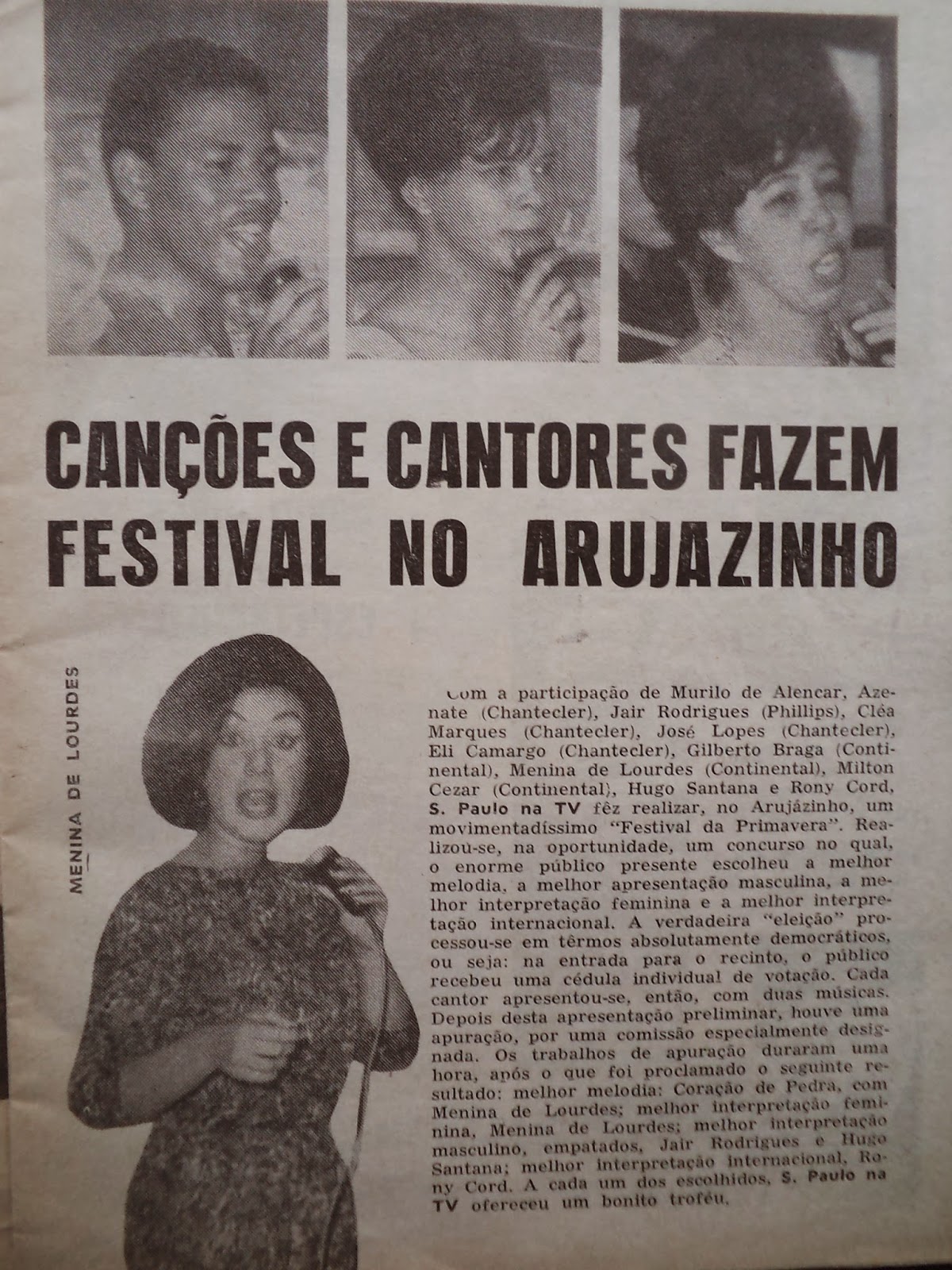
Menina de Lourdes ganha o pequeno Festival da Primavera de Arujazinho, na cidade de Arujá-SP, localizada na região Norte da Via Dutra, organizado pela revista São Paulo na TV. A platéia votou 'Coração de pedra' a melhor melodia, e Menina de Lourdes (Contintental) ganhou o prêmio de melhor cantora, ficando o prêmio de melhor cantor empatado entre Jair Rodrigues (Philips) e Hugo Santana (Continental). Ronnie Cord ficou com o prêmio de melhor cantor internacional. A folclorista Ely Camargo e José Lopes, ambos da Chantecler, também participaram do certame, além de Murilo Alencar, Azenate (Chantecler), Cléa Marques (Chantecler) & Gilberto Braga (Continental).  Notícia da revista 'SP na TV' de 2nd December 1963.  
Menina de Lourdes recebe Nino Dourado, em sua casa no Pequeri, em 13 Janeiro 2028.

Thursday, 31 March 2016

BENITO DI PAULA 1974-1975

Some acts suddenly come out of 'nowhere', rule the charts for a couple of years and go back to semi-ostracism. That's what more-or-less happened to Benito di Paula and his piano playing.

Benito had been singing and playing his piano at night clubs in Rio and Sao Paulo since the mid-1960s. He even had a 'night-club-hit' with 'Retalhos de cetim' that became a favourite with night club patrons but Copacabana Discos refused to record it when they first signed him. When Copacabana finally recorded 'Retalhos de cetim' in late 1973, it went straight to Number One. 

By mid 1974 Benito recorded 'Benito di Paula gravado ao vivo' a 'fake' live-album which shot to the top of the Album Charts, spawned at least 4 singles that played throughout 1974 and 1975 becoming the best selling album of 1974. 

Soon after, Benito got his own weekly TV programme, 'Brasil Som 75', on TV Tupi  from which he recorded a second live-album that went to #1 too for a couple of weeks.

And that was about it. By 1976 Benito could not keep up the pace he had created and faded into humdrum.  


December 1969 - Monthly musical magazine 'Melodias', edition # with an article about new-comer Benito di Paula who wrote 'Canção para o nosso amor' b/w 'Nino' that played at the opening of 'Nino, o italianinho', a nightly tele-novela showing 6 days a week at TV Tupi. Even though the novela was highly successful, Benito was hardly noticed. He would have to wait another 4 years to break into the charts with 'Retalhos de cetim' in late 1973. 


Monday, 28 December 2015

Brazilian Hybrid-English acts 1971-1975

As of 1971, Brazilian show business started a new trend which I quaintly call Hybrid English Acts or Hybrid English Songs. Actually, Brazilians were only following an international trend started elsewhere a few years back in which acts from non-English-language countries would write and perform songs in English.

I particularly call this trend 'Hybrid-English' because most of this material was beset with heinous grammar mistakes. Sometimes song-writers would simply invent words in disconnected sentences that would make no sense whatsoever. To top it all off most of these acts had an atrocious pronunciation of Shakespeare's tongue.

Terry Winter aka Tommy Standen was probably the first Brazilian act to avail himself of such a gimmick releasing 'You'll notice me' in late 1971 for New Records, a label deliberately set up by Copacabana Discos with the intention of selling Brazilian acts disguised as 'international stars'. 

By 1973, Hybrid English records were all the rage and Chrystian aka Jose Pereira da Silva Neto took 'Don't say goodbye' all the way to #1 which ended up as the best selling record of 1973. 

Chrystian from Goias and Gretchen from São Paulo recorded only in English.

Ever since 1971 when Brazilian singer-song-writer Thomas Standen suddenly changed his name to Terry Winter and recorded 'You'll notice me' in English for Copacabana Discos's new subsidiary New Records as if he were a foreign act there was a new trend. Brazilian singers with high-pitched voices were in demand from local labels to record melodic romantic tunes written in English by Brazilians.

1973 turned out to be one of the best years for those singers who recorded this sort of Hybrid English. They were Portuguese-speaking young musicians who grew up listening to romantic Anglo-American ballads like those sung by the Beatles and Bee Gees and somehow got hold of elementary English grammar skills to ape those melodies and write whatever English they could grasp.

Most of the songs would be written in 'mangled English' but nobody would give a hoot because after all the buying public did not understand the lyrics in the first place. One had only to fill in the blanks with whatever nonsense they came across, then find a singer with a high-pitched melodic voice, hire some session musicians and studio time and there you were: a new foreign-act sensation. Especially if one of the TV networks would chose your tune to be the 'love theme' of Mary or Jane at some tele-novela that would drag its feet from 8 to 12 months.

Chrystian (born Jose Pereira da Silva Neto on 3 November 1956, in Goiania-GO; died on 19 June 2024) was 16 years old in late 1972 when this trend was at its peak. Chrystian was perfect for the role of a romantic balladeer who woos the hearts (and ears) of millions of TV addicts that watched saccharine soap-operas six nights a week. He had been a Brazilian country singer called simply Zézinho since childhood. His family eventually moved to Sao Paulo where he finally recorded for Continental Discos.

Chrystian was actually hanging out at the RCA Victor studios on Rua Dona Veridiana in Sao Paulo where he used to do back-up singing for other acts when a record-producer approached him and told him there was a commission from TV Globo for a love-song that would play every time popular husband-and-wife duo Tarciso Meira & Gloria Menezes showed up on the small screen in their next tele-novela 'Cavalo de aço' (Iron horse) that would beam from 24 January through to 21 August 1973.

TV Globo wanted a singer with a velvety voice and Chrystian's voice was just like an angel's. As Chrystian knew blind-key-board player Sergio Sá aka Paul Bryan had a tune just waiting on the side lines for such a purpose, they went up to Fabio Junior's house (Fabio aka Jim Saloman) sat themselves down and finished writing 'Don't say goodbye' that fitted like a glove into the drama and went to # 1 as soon as they released it as a single. It stayed on the top of the heap for 8 weeks.

Chrystian turned out to be one of the best and most prolific of all Hybrid English-acts having a string of hits like 'Tears' and 'More than you know' while most of other acts were one-hit-wonders.

Morris Albert was the one and only H.E.A. that broke into the US market having taken his 'Feelings' to #5 at Billboard in 1975.

Dave MacLean aka Jose Carlos Gonzales (Carlão) first hit with 'Me and you' (played on novela 'Os ossos do barão') and then again with 'We said goodbye' both in 1974. 'We said goodbye' was #1 in Mexico and other Latin countries.

Chrystian, Dave MacLean and Sunday's lead vocalist Helio Eduardo Costa Manso all had beautiful melodic voices. It's a pity the songs they sang although of good quality melodically were such disasters when it came to grammar and meaning. But that's what one gets when one lives in a country with such a huge cultural cringe as Brazil.

Pete Dunaway aka Otavio Augusto Fernandes Cardoso had his biggest hit with 'I'll be fine' played every night on TV Tupi's novela 'Mulheres de areia' which ran from 26 March 1973 through to 5 February 1974.
Light Reflections, a rock band from Sao Paulo kept strong at the charts with 'That love'; Paul Bryan aka Sergio Sá had placed two hits at the charts so far this year: 'Window' and 'Listen'; and now we had a new singer-song-writer from Sao Paulo called Morris Albert aka Mauricio Alberto Kaisermann whose 'The throat' was being well played at DJ Big Ben's show at Salvador's Radio Cultura da Bahia.
before Pete Dunaway fled to TV Globo's Som-Livre had a few hits on TV Tupi's novelas like 'I'll be fine' in 'Mulheres de areia' (1973) and 'Believe me, darling' in 'Os inocentes' (1974).
Pete Dunaway aka Otavio Augusto Fernandes Cardoso soon moved on to TV Globo where he recorded this album and became an insider at Som-Livre, Globo's own recording label.
Most of performers of Hybrid-English songs avoided being photographed but Pete Dunaway went all the way and showed his face on the sleeve of his 1974 album for Som-Livre. 
Sunday were the very first Brazilian act to record in English as if they were a 'foreign-act'. They covered Lou Christie's 'I'm gonna get married' that played incessantly on two of TV Tupi's soap-operas: 'Beto Rockfeller' (ran from 4 November 1968 through to 30 November 1969) and 'Super plá' (ran on TV Tupi from 1st December 1969 through to 16 May 1970). They were a rock-band from S.Paulo. 
blind singer Jean Carlo who started recording 'Eu nasci p'ra você' a cover of Pino Donaggio's 'Sono nato con te' in 1966 turned to recording in English in 1973 for Top-Tape when 'Another song' using a new name Michael Davis. The song was included in the sound-track of 'Semideus' and had a lot of air play. Next year - 1974 - Jean Carlo changed his name yet a 3rd time and became Edward Cliff having recorded 'I'll never walk alone again' which was included in 'SuperManoela'.
Mark Davis who became better known as Fabio Junior later on finally made it into the charts with 'Don't let me cry' penned by Pete Dunaway that found its way onto TV Globo's novela 'O espigão' that ran from 1st April 1974 through to 1st November 1974.
Morris Albert aka Mauricio Alberto Kaisermann (born in Sao Paulo on 7 September 1951) was the only Brazilian act that actually did the almost-impossible: to chart in the USA. Morris wrote, sang and recorded 'Feelings' for Copacabana's Charge Records reaching #1 in the Brazilian charts circa December 1974. Little did he know that 'Feelings' would reach #6 at the Billboard's Hot-100 on 25 October 1975.
Morris Albert recorded a whole album for Charger-Records, a label belonging to Copacabana Discos when 'Feelings' got to Number One in the Brazilian charts in December 1974. Little did he know this album would be picked up by RCA to be released world-wide less than a year later when 'Feelings' got to #6 at the Billboard singles' chart.
Pholhas with their fancy jackets they probably bought on their visits to the USA to acquire new sound equipament.
Terry Winter initially known as Tommy Standen looking gloomy on a winter day. Terry suffered from asthma which eventually killed him.